
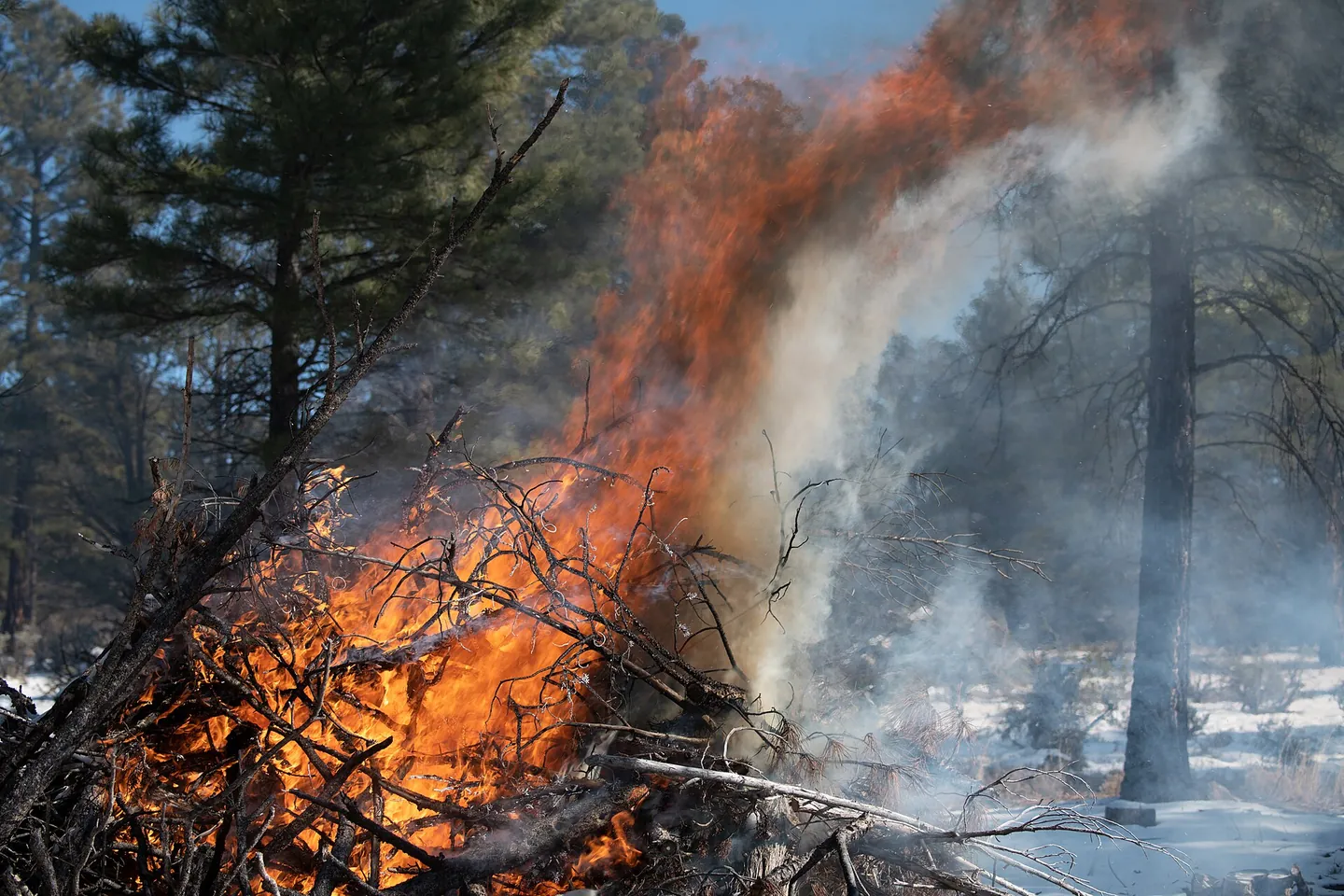
Do You Need a Burn Permit in Tennessee? Brush Pile Rules for Landowners
Yes, from October 15 through May 15. In that season, Tennessee requires a burn permit for a brush or leaf pile of any size. The permit comes from the Tennessee Division of Forestry. State law applies the rule to fires within 500 feet of any forest, grassland or woodland.
The permit costs nothing, and you get it on the day you burn. It is good for that one day only. The fire must be completely out by midnight.
Some cities and counties set stricter rules of their own, and a burn ban stops all open-air burning. This guide explains the state’s rules. It is not legal advice: the Division of Forestry and your city have the final word.
There is also a way to skip the pile. With forestry mulching, a mulching head grinds brush and small trees where they stand. The mulch stays on the ground, so there is no pile to burn and no burn permit to get. F and S Enterprises does this work around McMinnville and across Middle Tennessee.
How do you get a burn permit in Tennessee?
Apply online through Burn Safe TN, or use the MyTN mobile app. People with limited internet access can call the Division of Forestry’s burn permit phone line on weekdays. Callers can face long waits when call volume is high, so the state asks people to apply online.
Apply on the day you plan to burn, since a permit is good for one day. Have the fire completely out by midnight. To burn on another day, get another permit.
Permits are issued only when fire danger is at an acceptable level. Generally, the state does not issue them on dry, windy days.
Outside the October 15 to May 15 season, the Division of Forestry does not require a permit. Some cities and counties keep burn rules all year, so check locally before you burn.
What needs a burn permit, and what does not?
The Division of Forestry’s burn permit page sorts fires into two lists. From October 15 through May 15, these need a permit:
- Leaf piles
- Brush and other woody debris, like branches
- Storm debris
- Prescribed fires
These need no permit from the state:
- Fires in a container or barrel with a half-inch mesh screen cover
- Ceremonial fires
- Grilling
Some things should not be burned at all. The state’s environment agency keeps a list of what not to burn. It includes tires and other rubber products, building material and construction debris, and most vegetation not grown on site.
Have storm limbs or an old brush pile to deal with? Our grapple moves, piles or loads brush and downed limbs where you want them. That is our debris removal work. If the pile gets burned later, the burn and its permit stay with the landowner.
What is the difference between a burn restriction and a burn ban?
A burn restriction is a pause on permits. High winds, very low humidity or extremely dry vegetation can push up the wildfire risk. Then the Division of Forestry stops issuing burn permits until conditions improve. No one may conduct a burn that needs a permit until the restriction is lifted.
A restriction does not stop campfires, outdoor grilling or burn barrels with mesh covers. A burn ban goes further. It stops all open-air burning, including campfires, outdoor grills and leaf or debris piles.
Bans come when fire weather poses an uncommonly severe risk. At the request of county mayors, the Commissioner of Agriculture can issue a ban for specific counties. The Commissioner works with the State Forester on it. The Governor can also issue a ban for a region or the whole state.
The penalties differ too. Under state law, burning without a required permit is a Class C misdemeanor. Breaking a burn ban is a Class A misdemeanor. That carries a fine of $2,500, up to 11 months 29 days in jail, or both. You may also be liable for damage your fire and smoke cause to other people’s property, the Division warns.
Do city burn rules come before the state permit?
Yes, where a city or county has its own rules. State law steps aside inside a city that has passed its own fire ordinance. There, the city’s rules apply. The Division of Forestry’s page also says local restrictions supersede state rules.
The state keeps a list of places with their own stricter burn rules. In Warren County, McMinnville and Morrison are on it. So are Manchester, Tullahoma, Shelbyville, Crossville, Sparta, Cookeville and Lebanon.
Inside McMinnville, the city code covers burning too. Its list of things you may not burn includes leaves and trees not grown on site. Only special permission from the fire chief changes that.
If your land sits inside city limits, the state says to check with the city before you burn. Ask the county about its rules, too.
How do you burn a brush pile safely?
The Division of Forestry lists these steps for a safe debris burn:
- Rake or plow a firebreak around the area you want to burn.
- Make the bare ground at least 3 feet wide through leaves or short grass. Make it at least 5 feet wide through tall grass or brush.
- Burning wooded land? Let the adjacent landowners know at least 2 days ahead. The law calls for it.
- Keep water and tools on hand for escaped embers or flames.
- Keep debris piles small, and add to the fire as it burns down.
- Pick a spot away from overhanging branches and utility lines.
- Stop burning if a strong wind comes up, even with a permit.
- Stay with the fire until it is completely out and cooled.
That last step is the law, too. State law makes it unlawful to leave a fire unattended within 150 feet of forest or woodland. The fire has to be fully put out first.
Why does Tennessee watch debris burning so closely?
Tennessee averages about 1,000 wildfires a year, burning about 18,000 acres. More than 90 percent are caused by people, including escaped debris burns. The Division of Forestry calls escaped debris burns the leading cause of wildfires in Tennessee.
The permit is one of the state’s key ways to tell people where, when and how to burn safely. Your fire is your responsibility from the moment the match is lit until it is dead out, the Division says.
How can you clear brush without burning it?
F and S Enterprises clears brush with a forestry mulching head on a compact track loader. The head grinds brush, briars, saplings and small trees into mulch where they stand. The mulch stays on the ground and feeds the soil. With no pile, there is nothing to burn and no burn permit to get.
For lighter growth under the trees, brush clearing mulches down briars, privet, honeysuckle and saplings with the same head.
F and S is based in McMinnville and works about 60 miles around it, across Middle Tennessee. We look at the property and put the quote in writing before the work starts. Call or text (831) 236-5783 for a written quote, or read how forestry mulching works.