
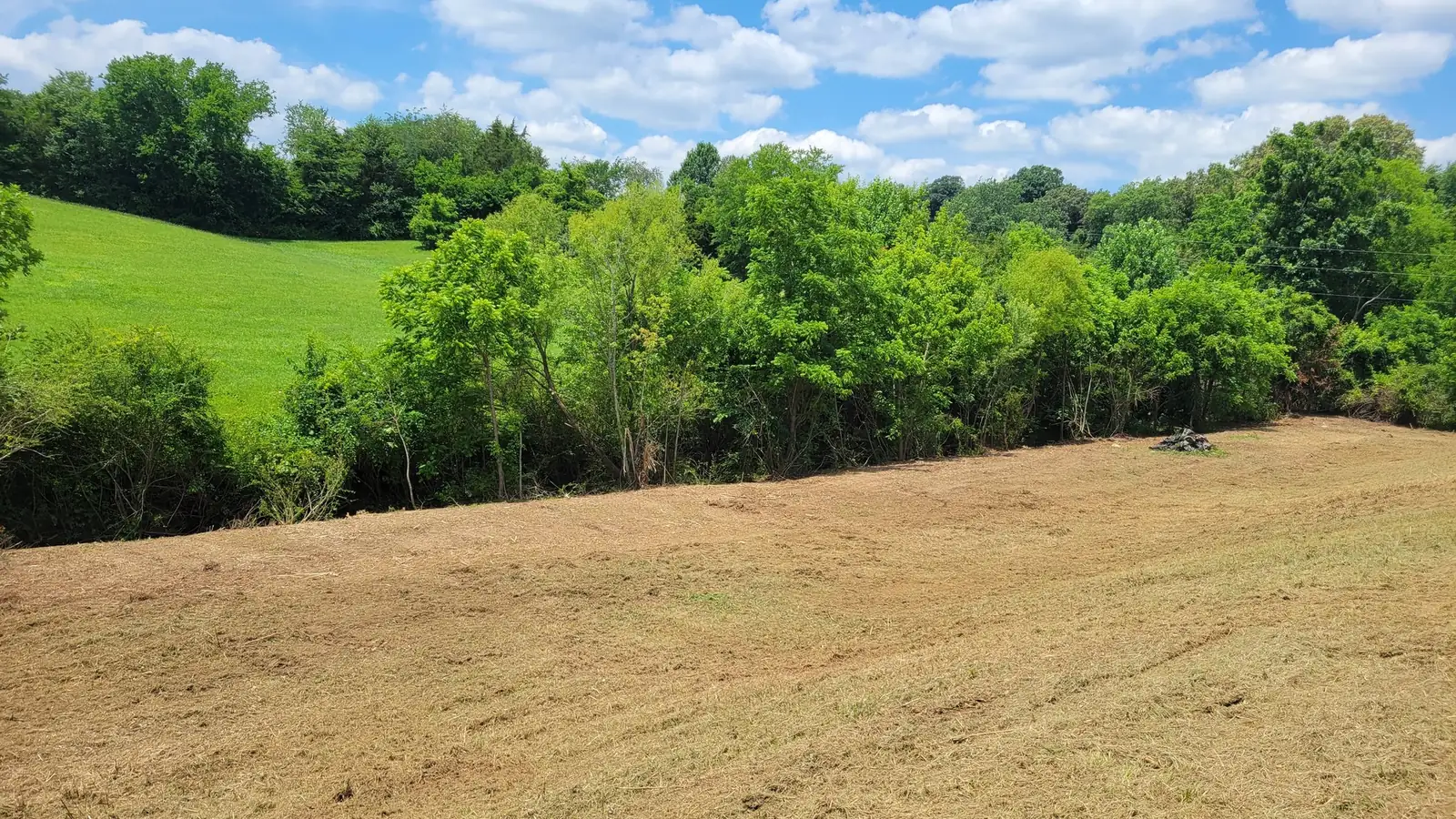
What Does Forestry Mulching Cost per Acre in Tennessee?
Published cost guides put forestry mulching at about $400 to $3,500 an acre, and more for the heaviest growth. By the hour, they quote $125 to $350 for the machine and its operator. A state-by-state cost directory lists Tennessee mulching at $1,105 to $1,950 an acre.
Those are market numbers, not our price list. Light growth on open ground sits at the low end. Thick growth on steep, rocky ground sits at the high end. For how the work itself goes, see our forestry mulching service page.
What do cost guides list per acre and per hour?
Every figure below was published in 2025 or 2026, and each source measures a little differently.
| What is priced | Published range | Kind of source |
|---|---|---|
| Per acre, national guide figures | $400 to $800 | three national pricing guides |
| Per acre, light growth | $500 to $1,500 | a national land clearing directory |
| Per acre, moderate growth | $800 to $2,500 | the same land clearing directory |
| Per acre, heavy growth | $1,500 to $3,500 | the same land clearing directory |
| Per acre, brush cleared with a mulcher | $1,500 to $4,500 | a national brush clearing directory |
| Per acre, Tennessee | $1,105 to $1,950 | a state-by-state cost directory |
| Per hour, machine and operator | $125 to $350 | national pricing guides and the land clearing directory |
| Per day, clearing equipment and operator in Tennessee | $2,600 to $4,000 | the state-by-state directory |
| Moving the machine to the job | $300 to $800 per job | the brush clearing directory |
The land clearing directory sorts growth into bands. Light growth is grass and vines with sparse brush and easy access. Moderate growth adds saplings and thicker brush. Heavy growth means dense brush and larger small trees, or hard conditions.
The national figures do not name the growth they assume. The directory bands do, so match your land to a band. The directory calls them planning ranges, not quotes.
Should you compare quotes by the acre or by the hour?
A per-acre quote should name the growth and the finish it assumes, the land clearing directory says. An hourly quote puts slow ground on your bill instead. The same directory says it should explain whether moving the machine, travel, fuel and cleanup are separate.
A national brush clearing directory puts a mulcher at 4 to 8 hours an acre in medium brush. At $125 to $350 an hour, the math puts that acre at about $500 to $2,800. Heavy brush takes 6 to 12 hours an acre in the same guide.
Our mulching head runs on a high-flow compact track loader. Most of our forestry mulching jobs take a day, and some take two or three. We bill by the hour, plus tax and transportation, and the quote comes in writing.
What moves the price on your land?
- How thick the growth is. Briars and saplings mulch fast. A thicket of cedar and privet is a dense stand. Dense stands take more passes and more fuel, the land clearing directory notes. If the growth is mostly under mature trees, brush clearing is the lighter job.
- How big the trees are. Bigger trunks may need extra passes or a separate felling plan, the same directory says. Mature trees that need to come down are a tree service’s job, and that cost sits outside a mulching quote.
- Slope and rock. Rocky, uneven, wet or sloped ground can slow the machine, that directory says. Around McMinnville, the biggest soil area in the federal soil survey is Waynesboro loam on 5 to 12 percent slopes. On the Cumberland Plateau around Crossville, one of the two main soils sits just 7 to 20 inches over sandstone. Around Woodbury, the biggest area is Inman flaggy clay on 12 to 35 percent slopes. Flaggy means thin pieces of rock run through it.
- Access and the drive. Tight gates and creek crossings add time, and so does the trip to the job.
- How many acres. Small jobs cost more per acre because the trip and setup land on fewer acres. In the brush clearing directory’s example, a one-acre job might cost $3,000, and a five-acre job $2,400 an acre.
- What you want when it is done. A riding trail or a food plot covers a strip or a patch of the tract. The hours follow its size, and our page on trails and food plots covers that work.
Does forestry mulching cost less than bulldozing and burning?
Often it does, once the debris is counted. The land clearing directory notes that traditional clearing often costs more when the job needs steps beyond grinding the growth. In the state-by-state directory’s Tennessee table, mulching runs $1,105 to $1,950 an acre. Grubbing, which takes the stumps out, runs $2,600 to $4,160 an acre in the same table.
A national cost guide puts light forest clearing at $733 to $2,333 an acre. Heavy woods run $3,395 to $6,155 an acre, and neither figure includes grading.
Clearing with a dozer leaves the trees and brush to deal with. Hauling that debris off runs $500 to $2,000 or more an acre, the brush clearing directory says. Burning the piles on site runs $200 to $500 an acre where it is allowed.
The state forestry agency requires a burn permit for brush and leaf piles from October 15 through May 15. Each permit is good for one day, and the agency pauses permits when conditions turn hazardous. The agency also names escaped debris burns as the leading cause of wildfires in Tennessee.
Mulching skips the pile and the haul. The chips stay on the ground where they fall. One national cost guide counts that as an advantage, because the haul-off cost drops out. Federal forest research says mulching moves ladder fuels, the brush that lets fire climb into trees, to the forest floor.
Clearing for a house is a different job. The building area and the drive usually need the stumps out and the ground rough-graded. That is site preparation for a new build, with its own steps and its own quote.
What belongs in a written mulching quote?
Read any mulching quote for these lines before you sign it.
- The lines. Where the work starts and stops. Flag the corners and any property line you want followed.
- What stays. The trees you want kept, plus the fence and the well to work around.
- The growth it assumes. The density, the tree size, the number of passes and the finish.
- How it is priced. By the hour or by the acre, with the transportation and the tax written in.
- What it leaves out. Stump grinding and tree removal are other trades. The quote should say whether either one is left for someone else.
- Hard spots. What happens if part of the land is too wet or too steep to reach.
We look at the property and put the quote in writing before the work starts. A paper contract follows, and then the mulching head goes to work.
How do you get a written quote for your land?
Published ranges help you plan, but a look at the property sets your number. Call or text (831) 236-5783 with your acreage and what you want the land to become. We work about 60 miles around McMinnville, across Middle Tennessee. You can also read how our forestry mulching work runs before you call.